Assessments FAQs
Assessments FAQs
❓ What is the purpose of the survey?
❓ Who is conducting the survey?
❓ Will I be asked for my name or ID?
❓ What personal information is collected?
❓Is the experience the same for everyone?
❓Do I play a role in improving my work environment?
❓ Can my responses be traced back to me?
❓ Can gender and job level identify me?
❓ What happens if my group is very small?
❓Are my answers visible to management?
❓ How long does the survey take?
❓ What happens after the survey?
You can read more on the survey HERE
Participating in workplace surveys can create different concerns. Employees in leadership positions may worry about being blamed, while others may fear being targeted. However, when surveys are conducted in ways that protect all participants and focus on generating insights rather than assigning blame, they enable organisations to make informed decisions that support long-term sustainability. This benefits employees, employers, and the broader environment.
To support clarity and build confidence, below are some frequently asked questions to assist employees.
❓ What is the purpose of the survey?
To understand employee experiences and identify opportunities to improve the workplace, including engagement, wellbeing, and respectful behaviour.
This is a learning and improvement initiative, not a reporting or disciplinary process.
❓ What will the survey cover?
The survey includes three areas:
Employee Engagement
Harassment Risk Assessment (workplace respect and behaviour)
Burnout (wellbeing, stress, and workload)
❓ Who is conducting the survey?
The survey is conducted and managed independently by the Resilient Workplace Institute.
This ensures confidentiality and independent handling of all data.
❓ Why should I participate?
Your participation helps ensure that the real employee experience is understood and acted on.
🎯 What’s in it for you
A chance to highlight workload and pressure points
Input into improving your day-to-day work environment
Strengthening respect and fairness in the workplace
Helping leadership make better, informed decisions
Contributing to a more sustainable and supportive environment
❓ Will I be asked for my name or ID?
No. You will not be asked for your name, ID number, email address, or employee number.
❓ What personal information is collected?
No personal identifiers are collected.
You may be asked to select general categories such as:
Gender
Job level
This is used to understand patterns across groups — not individuals.
❓Is the experience the same for everyone?
No. Employees do not experience these conditions in the same way.
Workplace experiences vary based on factors such as:
Job role and level
Team dynamics and leadership
Workload and environment
Individual circumstances
❓Do I play a role in improving my work environment?
Improving the workplace is a shared responsibility — not only management’s.
🔍 What this means
Leadership is responsible for:
Setting standards
Taking action based on insights
Creating the conditions for a safe and respectful workplace
Employees play an important role by:
Participating honestly in initiatives like this survey
Treating others with respect
Contributing to a positive and professional environment
🎯 Why your role matters
A workplace is shaped by daily behaviour, not just policies.
👉 When employees:
Speak up (safely and anonymously)
Engage constructively
Support respectful interactions
It helps create a workplace where:
Issues are identified earlier
Risks are reduced
Teams function more effectively
🔒 How this survey supports your role
This survey gives you a safe, anonymous way to contribute:
No names or identifiers
No risk of being singled out
Your input contributes to real insight and action
❓ Can my responses be traced back to me?
No. Your responses are completely anonymous and cannot be linked to any individual.
❓ Can gender and job level identify me?
No. These are broad categories and are not linked to any personal identifiers.
❓ What happens if my group is very small?
To protect anonymity:
Results are only reported where there are enough responses in a group
Small groups (e.g. a specific gender at a specific job level) will be:
Combined with a larger group, or
Only included in the summary view
👉 This ensures that no individual can be identified under any circumstances
❓ Who will see my responses?
Individual responses are never shared. Your responses are grouped (aggregated) into the overall results.
We report the summary insights to Management, who will plan interventions to reduce patterns as needed. The outcome and the planned actions will be shared with employees.
❓Are my answers visible to management?
No. Neither managers nor the organisation will have access to individual responses.
❓ How is my data protected?
Responses are:
Collected securely
Stored without identifying information
Processed using non-identifiable system-generated codes
Analysed independently by a third party
❓ How long does the survey take?
Approximately 5–10 minutes.
❓ Why should I participate?
Your input helps:
Improve working conditions
Strengthen respect and fairness
Address workload and wellbeing challenges
Support better leadership decisions
👉 If it is not measured, it cannot be improved.
❓ What happens after the survey?
Once the survey closes:
Responses are analysed independently by the Resilient Workplace Institute
Results are compiled into a structured report
Findings are presented to leadership in an aggregated (anonymous) format
Priority areas for improvement are identified
A summary of key findings is shared with employees
Next steps and planned actions are communicated
👉 You will see both what was found and what will be done about it
❓ When will we receive feedback?
After the survey closure, the report will be prepared and discussed with management in the month thereafter. Employees can expect to receive feedback within 2 months after the survey.
About The Resilient Workplace Institute
The HRA™ is an exclusively held, research-informed solution, supported by university partnerships to investigate data outcomes, presented at the International Labour Organisation, validated in academic studies, and trusted by over 40 organisations.
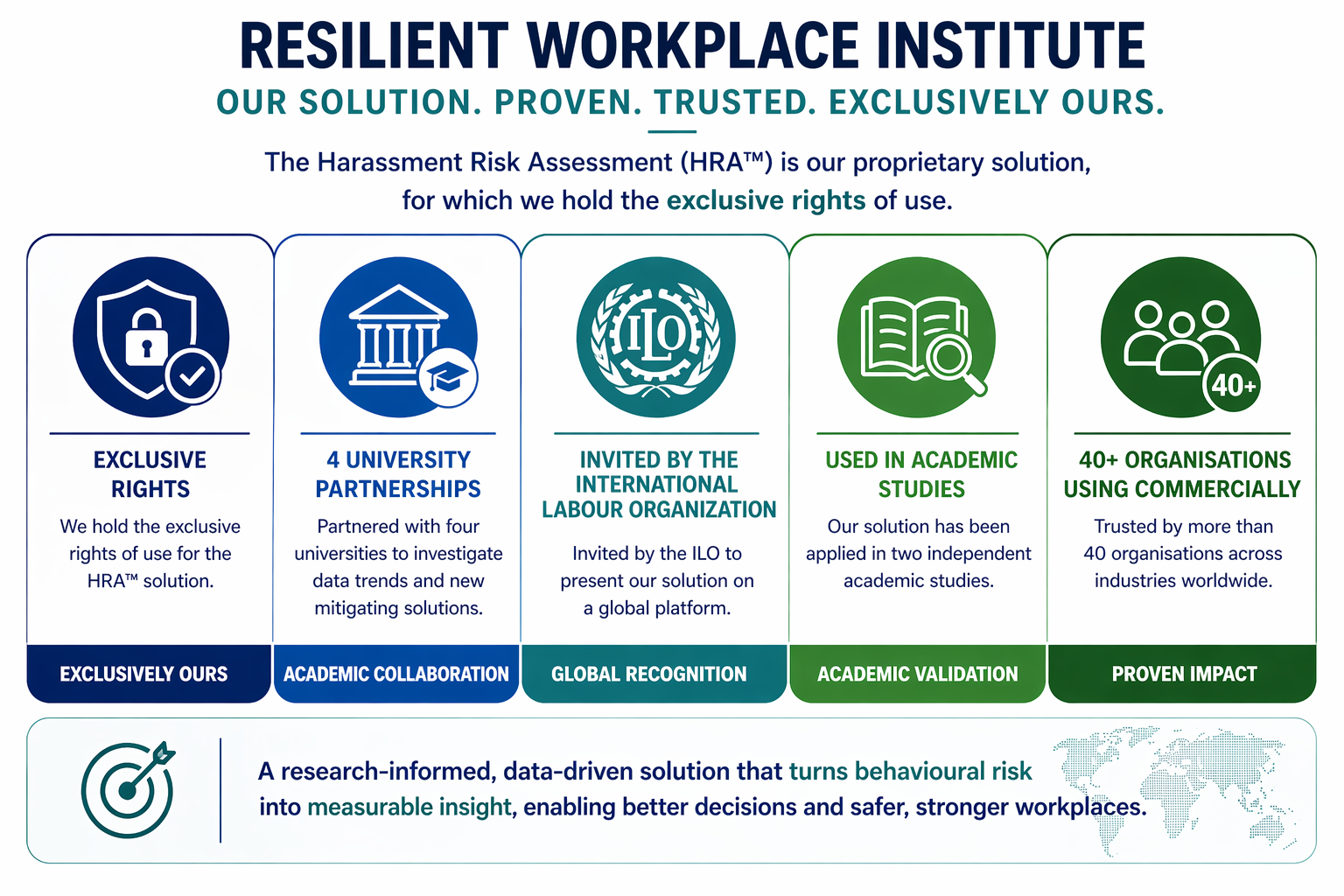
Read our Whitepaper HERE for deeper insight into the data and a ranking of harassment types.
For more information or a discussion: https://hanlie.resilientwork.org/