The Business Case for Culture: Low vs High Toxicity, Burnout, and Engagement
The Business Case for Culture: Low vs High Toxicity, Burnout, and Engagement
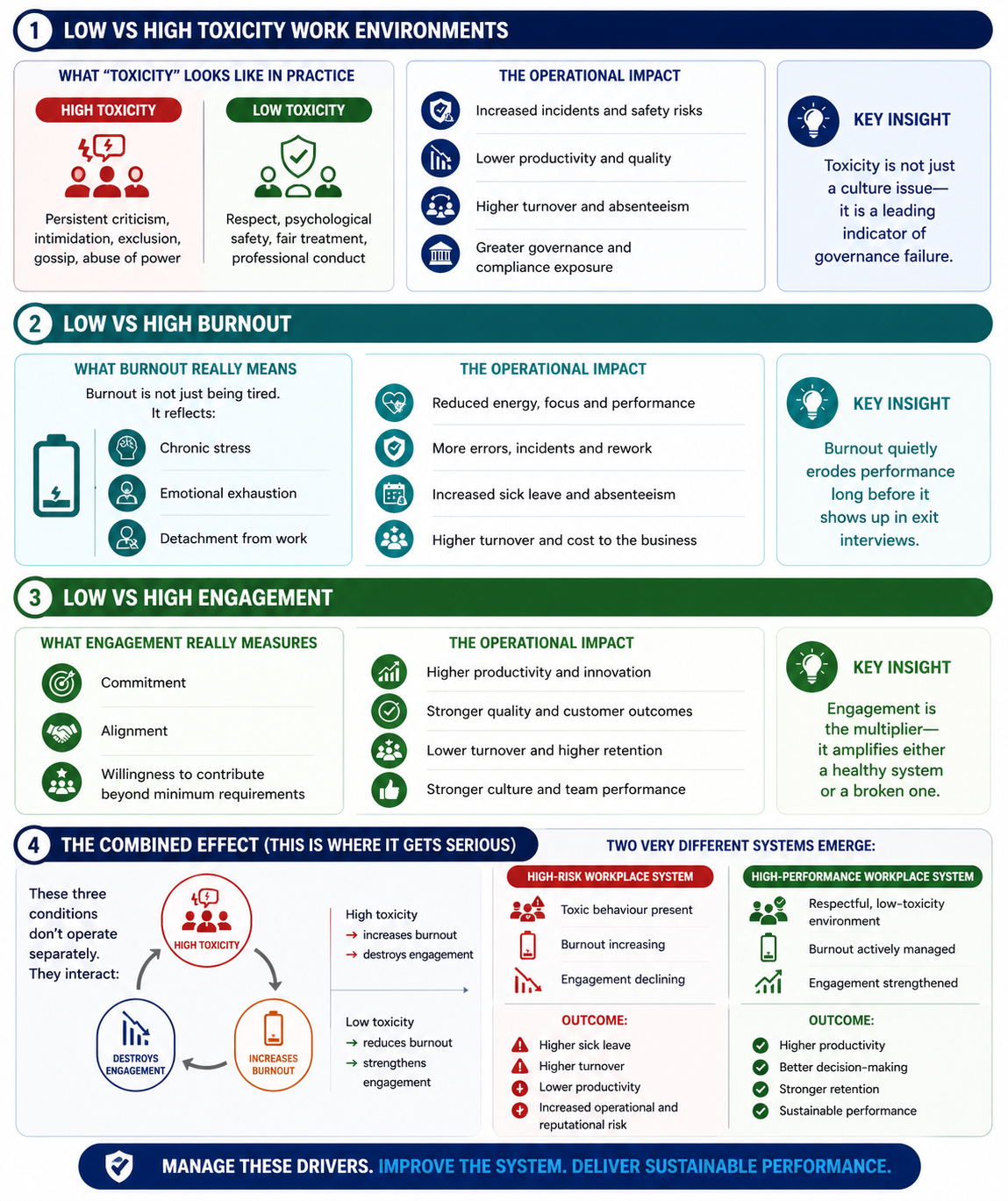
1) Low vs High Toxicity Work Environments
Read frequently asked questions HERE
Behavioural Risk Intelligence for High-Performance Organisations
A data-driven platform that converts workplace behaviour into measurable risk intelligence - enabling high-performing organisations to manage performance and governance with precision.
Workplace culture isn’t “soft.” It’s a measurable operating condition that shows up in productivity, safety, retention, and ultimately financial performance. When organisations move from high toxicity / high burnout / low engagement to the opposite state, the gains are not incremental - they’re structural.
Each can be measured individually, but together they provide the deeper insight needed to address root causes effectively.
1) Low vs High Toxicity Work Environments
What “toxicity” looks like in practice:
High toxicity: persistent criticism, intimidation, exclusion, gossip, abuse of power
Low toxicity: respect, psychological safety, fair treatment, professional conduct
The operational impact
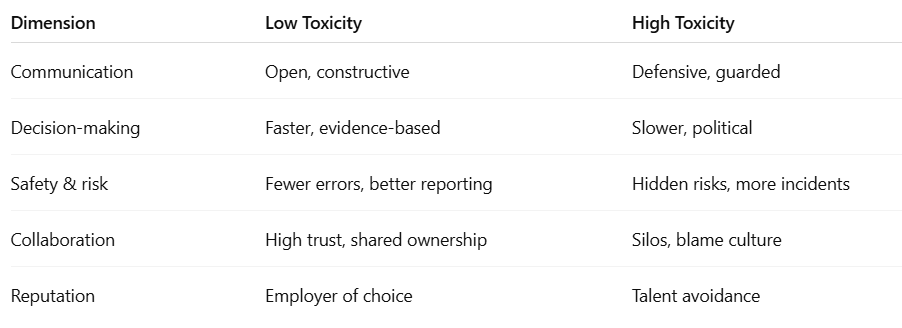
Key insight:
Toxicity is not just a culture issue—it is a leading indicator of governance failure.
2) Low vs High Burnout
What burnout really means
Burnout is not just being tired. It reflects:
Chronic stress
Emotional exhaustion
Detachment from work
The operational impact:
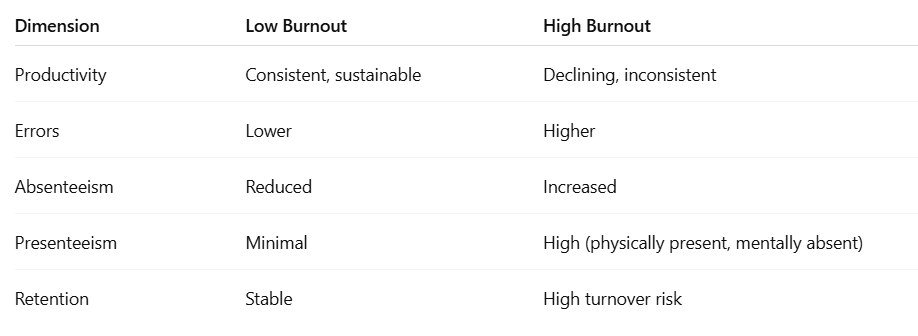
Key insight:
Burnout quietly erodes performance long before it shows up in exit interviews.
3) Low vs High Engagement
What engagement really measures
Engagement reflects:
Commitment
Alignment
Willingness to contribute beyond minimum requirements
The operational impact
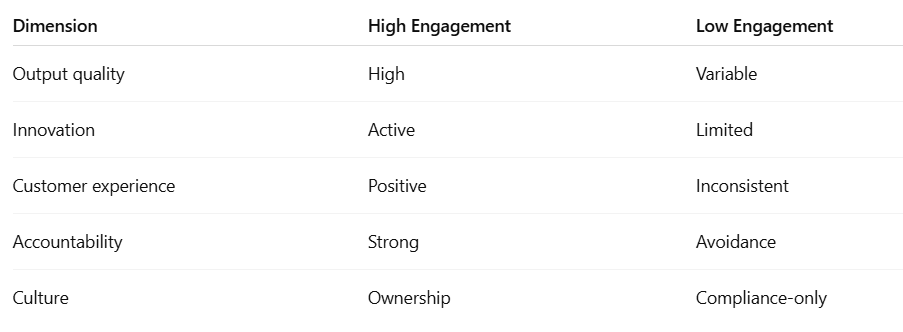
Key insight:
Engagement is the multiplier—it amplifies either a healthy system or a broken one.
4) The Combined Effect (This Is Where It Gets Serious)
These three conditions don’t operate separately.
They interact:
High toxicity → increases burnout → destroys engagement
Low toxicity → reduces burnout → strengthens engagement
Two very different systems emerge:
🔴 High-Risk Workplace System
Toxic behaviour present
Burnout increasing
Engagement declining
➡️ Outcome:
Higher sick leave
Higher turnover
Lower productivity
Increased operational and reputational risk
🟢 High-Performance Workplace System
Respectful, low-toxicity environment
Burnout actively managed
Engagement strengthened
➡️ Outcome:
Higher productivity
Better decision-making
Stronger retention
Sustainable performance
5) Why Measurement Matters
Most organisations:
Have policies
Run training
Respond to incidents
But few can measure the condition of their workplace in real time.
That’s the gap.
When organisations measure:
Toxicity (Harassment Risk)
Burnout (Wellbeing)
Engagement (Commitment)
They gain:
Early warning signals
Targeted interventions
Measurable improvement over time
6) The Strategic Takeaway
If it is not measured, it cannot be governed.
A low-toxicity, low-burnout, high-engagement environment is not accidental.
It is:
Designed
Measured
Managed
7) Closing Thought
A workplace does not become high-performing solely because of strategy.
It becomes high-performing when people can consistently operate at their best.
And that is only possible when:
Toxicity is low
Burnout is managed
Engagement is high
About The Resilient Workplace Institute
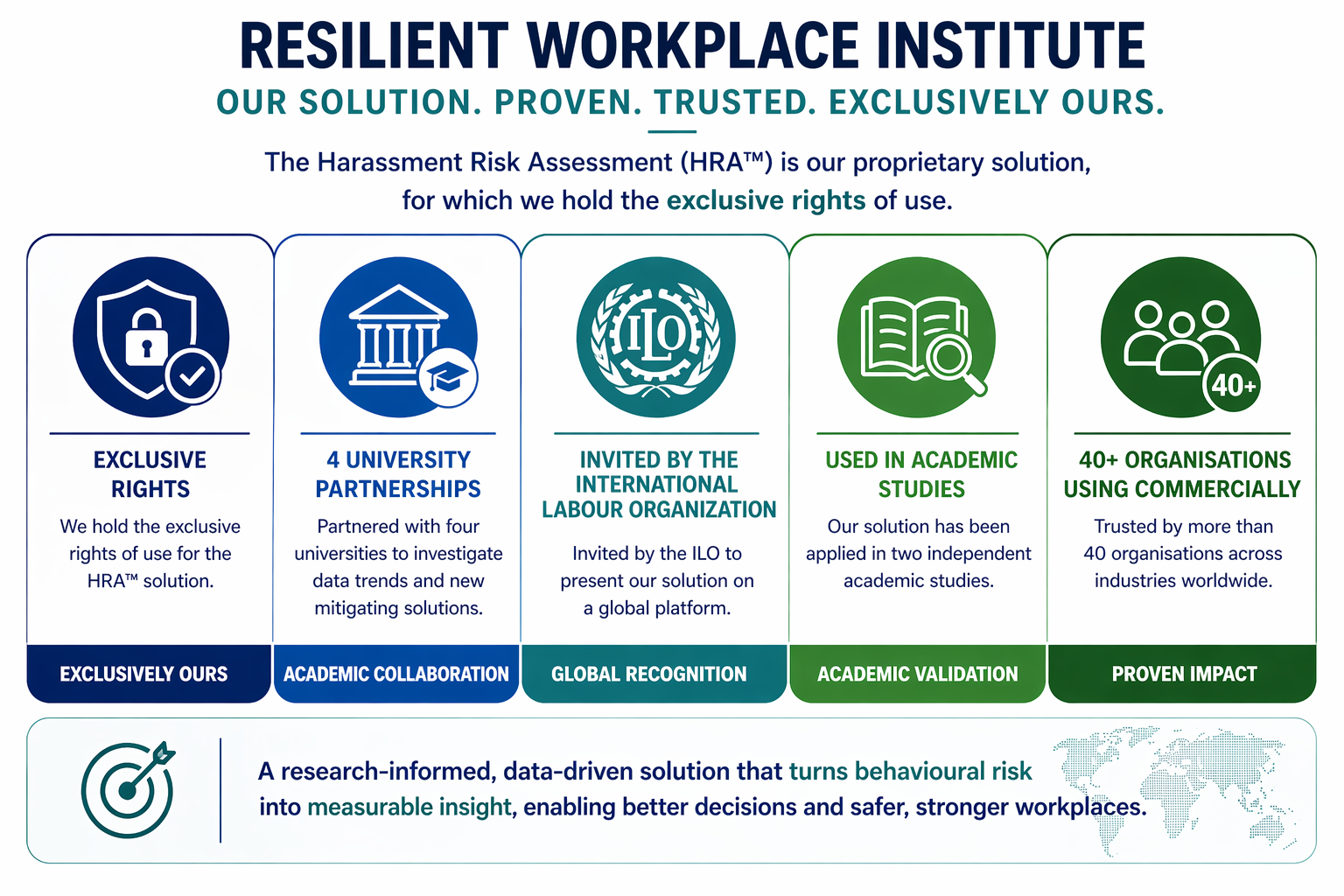
The HRA™ is an exclusively held, research-informed solution, supported by university partnerships to investigate data outcomes, presented at the International Labour Organisation, validated in academic studies, and trusted by over 40 organisations.
Read our Whitepaper HERE for deeper insight into the data and a ranking of harassment types.
For more information or a discussion: https://hanlie.resilientwork.org/