What must a graduate tolerate to keep an opportunity?
Hanlie Lizette Wessels
Article 02 | GBV & the Workplace
An unwanted touch. A humiliating remark. A threat. Pressure to resign.
For an established professional, challenging these behaviours can be difficult. For someone whose career has barely begun, the question may feel more immediate:
“If I speak up, will I still have a future here?”
Employers celebrate graduate recruitment, youth employment and investment in future leaders. But securing a first job is only the beginning. What happens inside that workplace matters.
An opportunity should never come with an unspoken price: tolerate harm to protect your future.
Findings from CLARITY, our workplace risk intelligence solution incorporating the Harassment Risk Assessment (HRA) and Harassment Risk Index (HRI), raise serious questions about what some young people encounter after the welcome presentations end.
What the assessments reveal
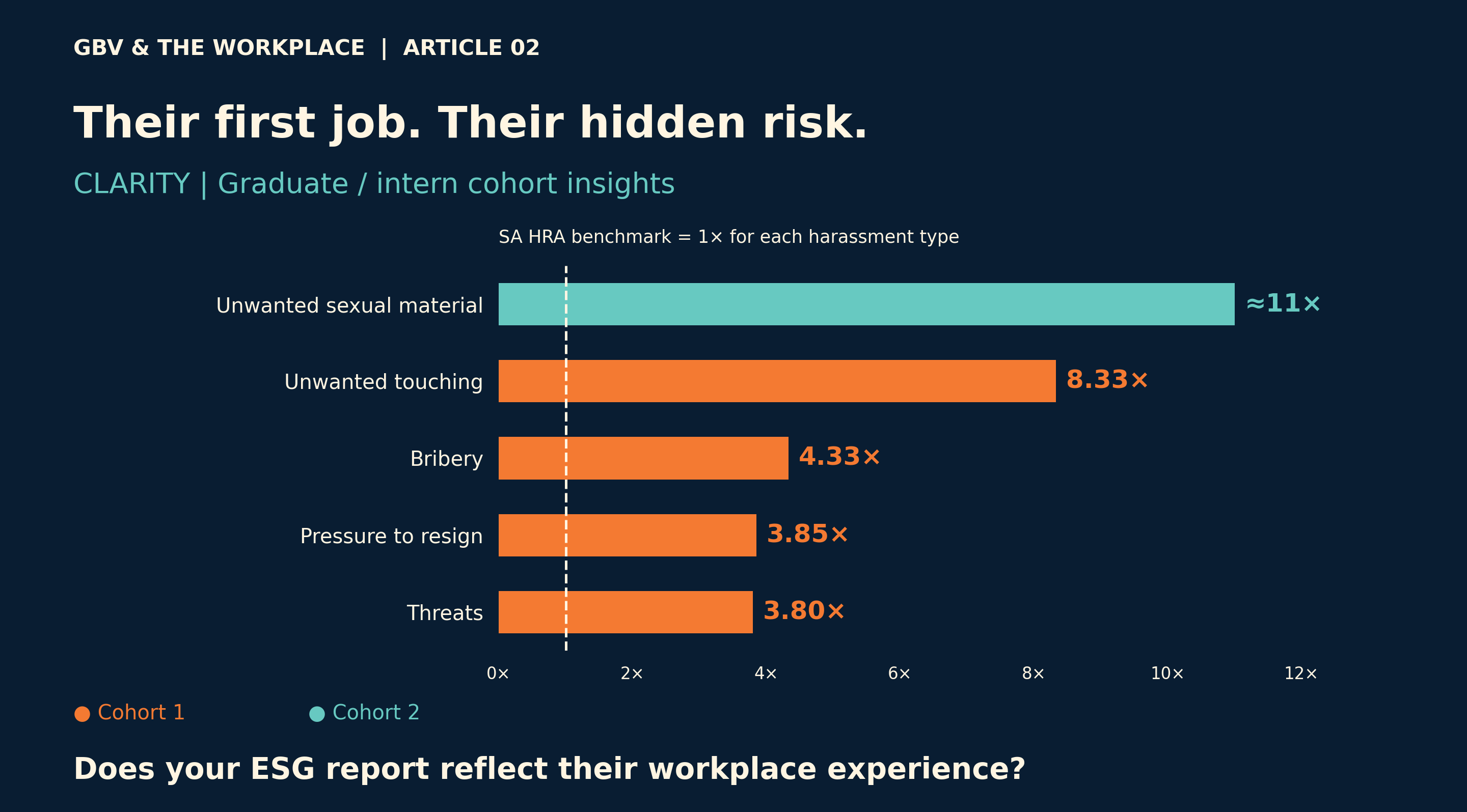
The accompanying graph highlights selected findings from two graduate/intern cohorts. With the South African CLARITY HRI benchmark set at 1 for each harassment type, the results show substantial differences in reported risk.
In Example 1, most categories were approximately two to four times the benchmark:
Unwanted touching: 8.33 times.
Bribery: 4.33 times.
Pressure to resign: 3.85 times.
Threats: 3.80 times.
Discrimination, humiliation, emotional abuse and constant personal criticism were also elevated.
In Example 2, the most pronounced spike was unwanted sexual material, at approximately 11 times the benchmark.
These are risk-score comparisons from two specific cohorts, not prevalence estimates for all South African graduates. They do not establish individual wrongdoing or explain every cause.
They are, however, findings that demand attention.
Your organisational average may conceal their experience
A board can receive an acceptable overall result while a small group within the organisation experiences substantially elevated risk.
Graduates and interns may be too few to move the overall score significantly. Their experience can disappear into the average.
That is why “our overall results look good” is an incomplete answer.
Good for whom?
For executives? Permanent employees? Established teams? Or also for the intern who depends on a supervisor’s recommendation to secure a permanent role?
CLARITY’s cohort-level analysis helps employers examine these differences and identify where further investigation and action are needed.
Who controls the opportunity - and who carries the risk?
A supervisor may influence a graduate’s rating, assignments, reference and prospects of appointment.
A policy may say, “Speak up.”
The employee may be thinking, “This person decides whether I stay.”
Publishing a reporting number does not establish that a young employee feels safe using it. Protection must be credible in practice: a route outside the reporting line, an impartial response, and attention to what happens after a concern is raised.
If criticism intensifies, opportunities disappear or exclusion begins, someone must examine the sequence of events. Those changes do not automatically prove retaliation. They cannot simply be ignored either.
Sexual harassment is part of a wider picture
The unwanted touching result in Example 1 warrants focused attention. So do the threats, humiliation and pressure to resign reported alongside it.
These findings do not prove that the same people were responsible or that the behaviours were connected. They show why employers need to investigate the broader environment.
Addressing sexual harassment while overlooking intimidation or humiliation can leave important parts of an employee’s experience unexplored.
A graduate should not have to understand the precise category of their mistreatment before an employer takes it seriously.
What kind of leaders are we developing?
Graduate programmes teach more than technical skills.
They teach people what authority looks like. What earns approval. Whether boundaries are respected. Whether organisational values apply when someone powerful is involved.
When humiliation is excused as “toughening them up”, what lesson is being taught?
When unwanted attention is dismissed as a joke, whose comfort matters?
When silence appears safer than reporting, what does the next generation learn about accountability?
Employers cannot credibly claim to develop future leaders while leaving harmful conduct in their training environment unexamined.
Recruitment, induction, mentoring and development are intended to build capability. Allowing harmful conditions to persist puts that investment - and the people behind it - at risk.
What does your ESG report say - and what does your graduate experience?
An organisation may report graduate appointments, training hours, youth employment expenditure and the number of young women entering its workforce.
Those achievements matter. But they leave a critical question unanswered:
What happens to those young people once they are inside?
An appointment count cannot tell us whether a graduate faces unwanted touching. Training expenditure cannot establish whether an intern can challenge humiliating treatment safely. A gender diversity statistic cannot show whether young women have a credible route to report someone who controls their career prospects.
The opportunity reported to stakeholders and the experience of the employee must be examined together.
This is where the social and governance dimensions of ESG meet: employees’ dignity and safety, and leadership’s responsibility to identify harm, act on it and monitor whether conditions improve.
CLARITY can inform that oversight by providing evidence of reported exposure, differences between workforce groups and changes across repeat assessments. That evidence should be considered alongside complaints, investigations and corrective action.
Low complaint numbers alone cannot establish that a program is safe. Employers also need to understand whether participants feel able to report.
If your ESG report celebrates investing in young people, can your board explain how it knows those young people are protected?
Leadership needs evidence, ownership and follow-through
Every organisation running a graduate or internship program should be able to answer:
Have we assessed this cohort separately, with safeguards for anonymity?
Do we know where risk is concentrated, including across placements and reporting relationships?
Can participants raise concerns outside the chain of authority that controls their opportunities?
Who is accountable for corrective action?
Have we checked whether conditions improved?
These questions belong with the executives sponsoring the program, alongside those responsible for people, risk, sustainability reporting and governance.
For South Africa’s workplace response to GBVF, young people’s first employment experiences deserve deliberate attention. Prevention must reach the places where careers begin and power is uneven.
Do you know whether your graduates and interns experience greater harassment risk than the rest of your workforce?
If you do not, reach out to explore how CLARITY’s HRA and HRI can help make those experiences visible, inform your enterprise risk assessment and direct action where it is needed.
A first job should open a future. It should never teach someone that keeping it requires surrendering their dignity.
Data note: Source: CLARITY HRA/HRI findings The Resilient Workplace Institute Impact Business Development (Pty) Ltd

