Behavioural Risk Intelligence Solution
Behavioural Risk Intelligence Solution
Harassment Risk Assessment (HRA™)
1. The Resilient Workplace Institute
2. Measure. Benchmark. Govern behavioural risk.
7. Designed for Global Organisations
Harassment Risk Assessment (HRA™)
Behavioural Risk Intelligence for High-Performance Organisations
A data-driven platform that converts workplace behaviour into measurable risk intelligence - enabling high-performing organisations to manage performance and governance with precision.
1. The Resilient Workplace Institute
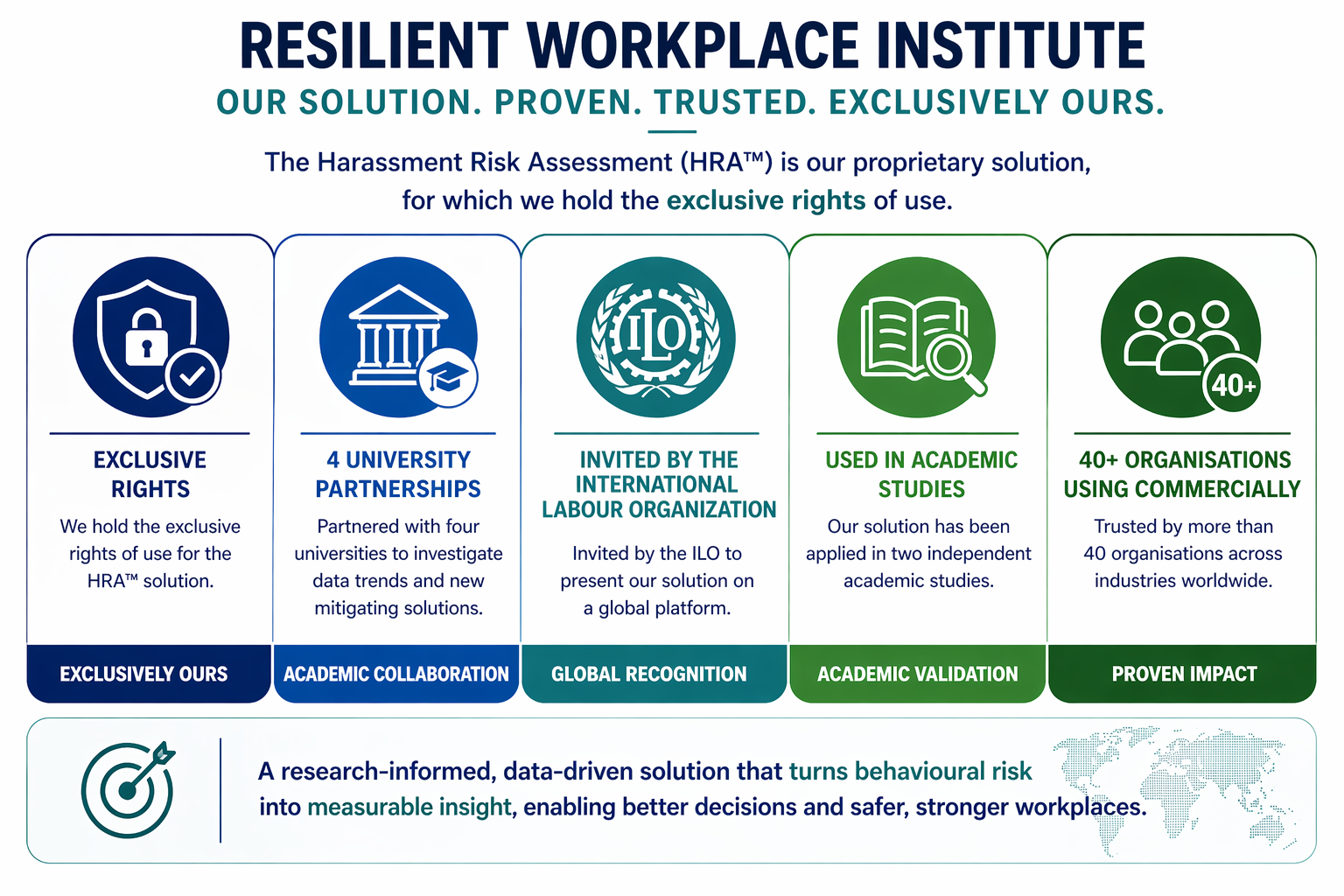
The HRA™ is an exclusively held, research-informed solution, supported by university partnerships to investigate data outcomes, presented at the International Labour Organisation, validated in academic studies, and trusted by over 40 organisations.
Read our Whitepaper HERE for deeper insight into the data and a ranking of harassment types.
2. Measure. Benchmark. Govern behavioural risk.
High-performing organisations measure what drives performance. Yet one of the most critical risks remains largely unmeasured:
Workplace behavioural risk.
Most organisations rely on policies, training, and reporting channels, but these do not provide measurable, decision-ready insight into risk levels. If behavioural risk cannot be measured, it cannot be governed.
3. The Solution
The Harassment Risk Assessment (HRA™) converts workplace behaviour into measurable, decision-ready intelligence.
At the core is the: Harassment Risk Index (HRI™)
A standardised metric that quantifies high and critical harassment risk per employee.
This enables organisations to:
Identify where risk exists
Understand how severe it is
Prioritise targeted interventions
Track measurable improvement over time
4. From Risk to Performance
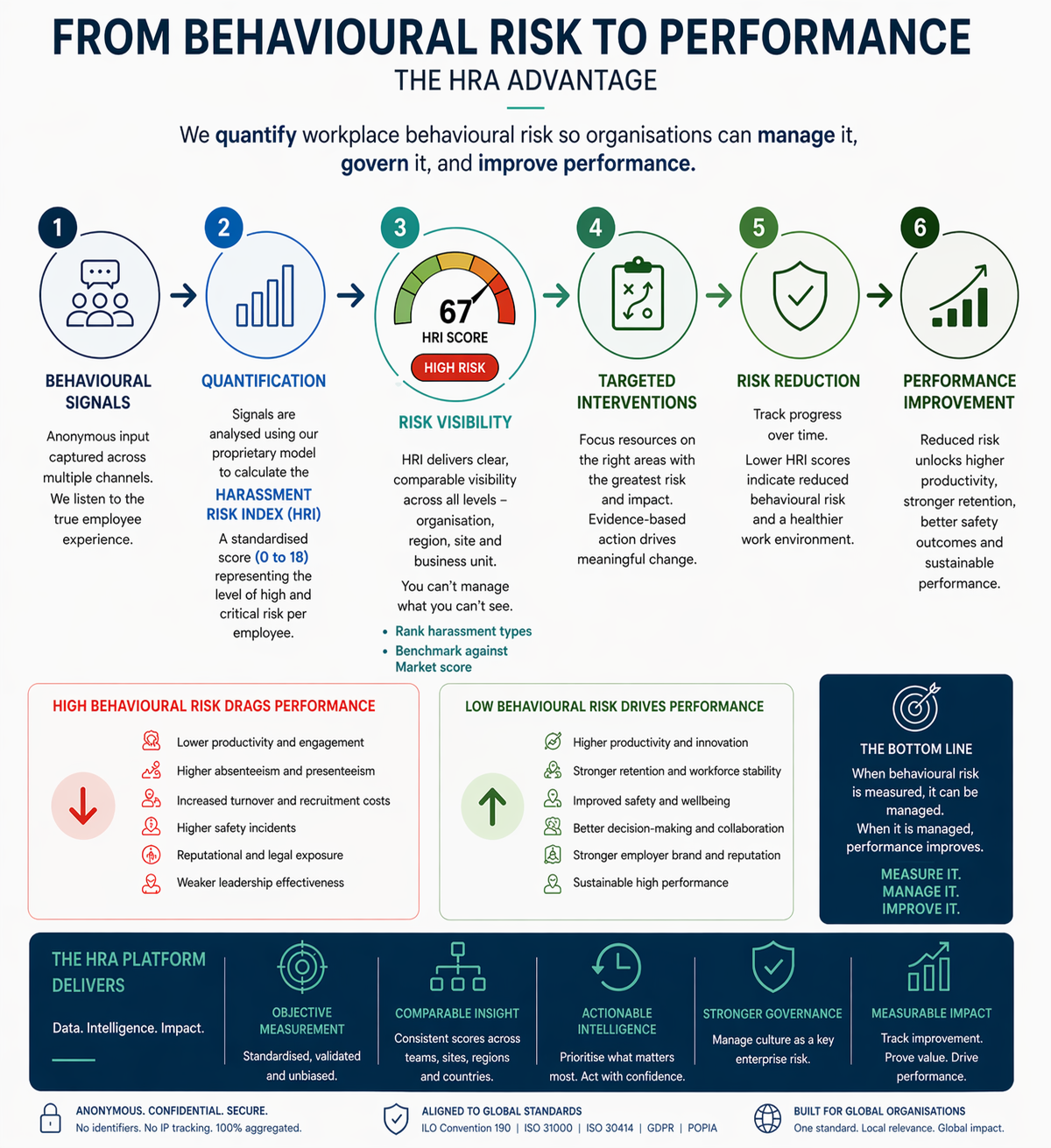
Behavioural risk is a hidden drag on performance.
When left unmanaged, it results in:
Reduced productivity
Increased absenteeism
Higher turnover
Weakened decision-making
Increased safety and operational risk
When measured and managed:
Risk ↓
Performance ↑
Quantified risk enables targeted action.
Targeted action drives measurable performance improvement.
5. How It Works
From Behavioural Signals to Measurable Performance Improvement
Behavioral Signals → HRI™ → Decision → Action → Monitoring
The Harassment Risk Assessment (HRA™) follows a structured, data-driven process that converts workplace behaviour into measurable, actionable intelligence.
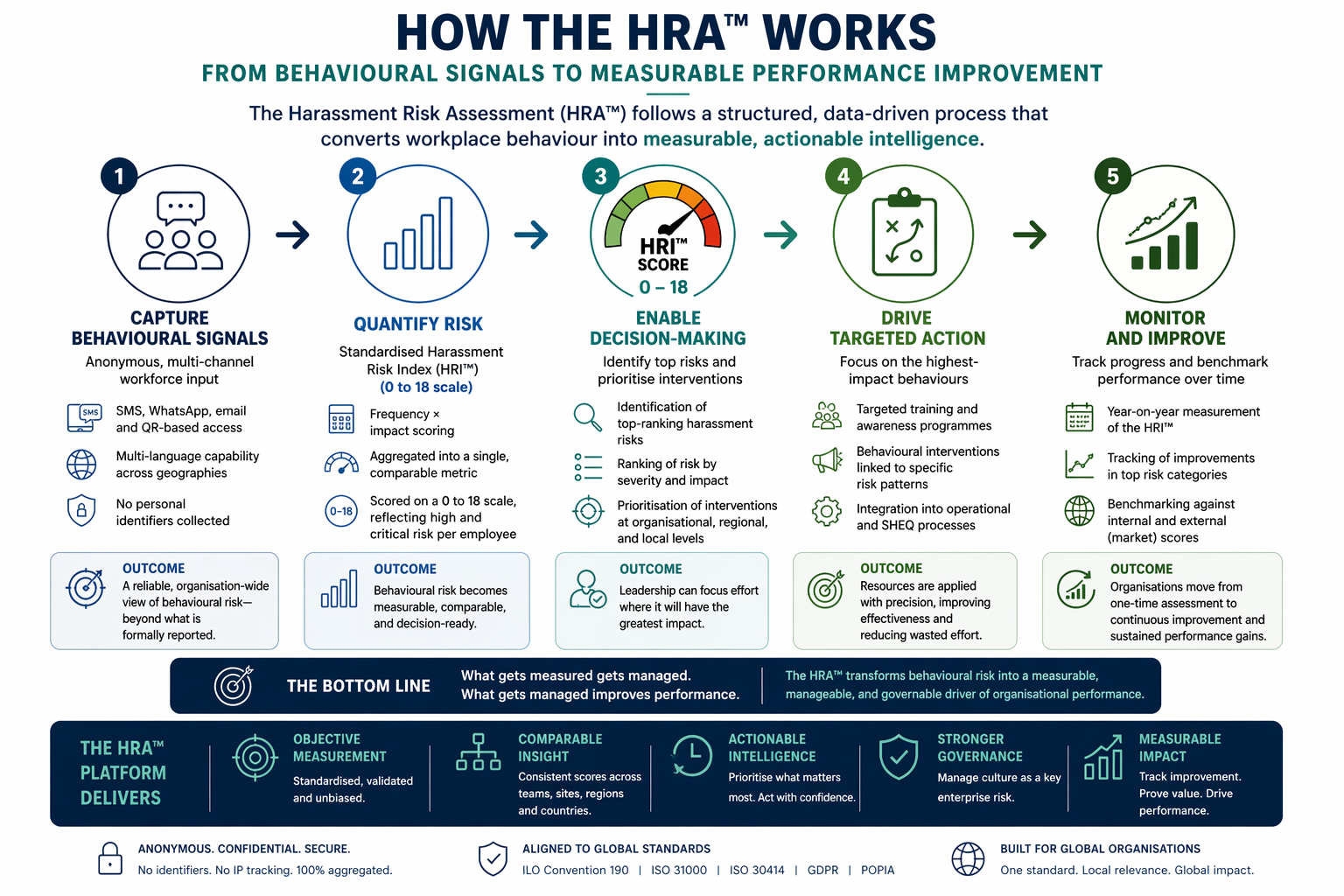
Capture Behavioural Signals
The HRA™ gathers anonymous workforce input across multiple channels, ensuring broad participation and accurate representation of workplace conditions.
SMS, WhatsApp, email, and QR-based access
Multi-language capability across geographies
No personal identifiers collected
Outcome:
A reliable, organisation-wide view of behavioural risk—beyond what is formally reported.
Quantify Risk
All inputs are translated into a standardised Harassment Risk Index (HRI™) using a structured methodology.
Frequency × impact scoring
Aggregated into a single, comparable metric
Scored on a 0 to 18 scale, reflecting high and critical risk per employee
Outcome:
Behavioural risk becomes measurable, comparable, and decision-ready.
Enable Decision-Making
The HRI™ provides leadership with clear visibility of where risk exists and where action is required.
Identification of top-ranking harassment risks
Ranking of risk by severity and impact
Prioritisation of interventions at organisational, regional, and local levels
Outcome:
Leadership can focus its effort where it will have the greatest impact.
Drive Targeted Action
Insights are translated into focused, high-impact interventions aligned to the organisation’s highest risks.
Targeted training and awareness programmes
Behavioural interventions linked to specific risk patterns
Integration into operational and SHEQ processes
Outcome:
Resources are applied with precision, improving effectiveness and reducing wasted effort.
Monitor and Improve
The HRA™ enables continuous tracking of progress and performance over time.
Year-on-year measurement of the HRI™
Tracking of improvements in top risk categories
Benchmarking against internal and external (market) scores
Outcome:
Organisations move from one-time assessment to continuous improvement and sustained performance gains.
Closing Insight
What gets measured gets managed.
What gets managed improves performance.
The HRA™ transforms behavioural risk into a measurable, manageable, and governable driver of organisational performance.
6. What This Enables
The Harassment Risk Assessment (HRA™) enables organisations to move from reactive culture management to proactive, data-driven governance of behavioural risk.
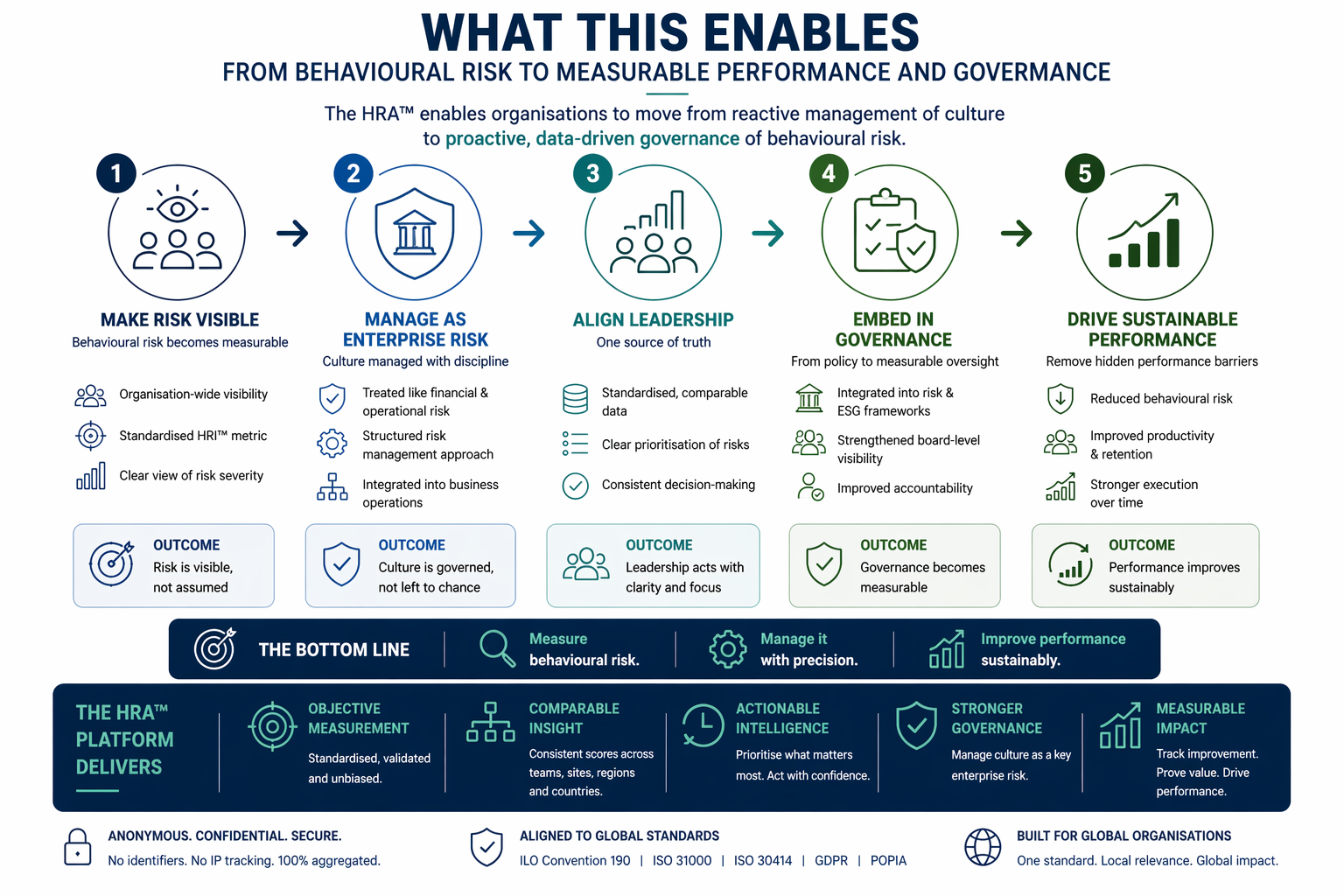
Make Behavioural Risk Visible and Measurable
Transform previously hidden or underreported behaviours into quantifiable, organisation-wide insight through the Harassment Risk Index (HRI™).
Outcome:
Leadership gains a clear, objective view of where risk exists and how severe it is.
Manage Culture as an Enterprise Risk
Elevate workplace behaviour from a “people issue” to a core enterprise risk category, managed alongside financial, operational, and safety risks.
Outcome:
Culture is governed with the same discipline and rigour as other critical business risks.
Align Leadership Around Data-Driven Decisions
Provide a single, standardised source of truth that aligns boards, executives, and operational leaders on where to focus and what actions to take.
Outcome:
Decision-making becomes consistent, prioritised, and evidence-based across the organisation.
Embed Behavioural Risk into Governance Frameworks
Integrate measurable behavioural risk into existing governance, risk, and ESG structures, strengthening oversight and accountability.
Outcome:
Organisations move from policy compliance to measurable governance performance.
Improve Organisational Performance Sustainably
Reduce behavioural risk to remove hidden performance barriers, enabling stronger execution, retention, and productivity over time.
Outcome:
Performance improvement is measurable, sustained, and aligned with long-term organisational outcomes.
The HRA™ transforms behavioural risk into a measurable, manageable, and governable driver of high performance.
7. Designed for Global Organisations
Managing behavioural risk at a global scale
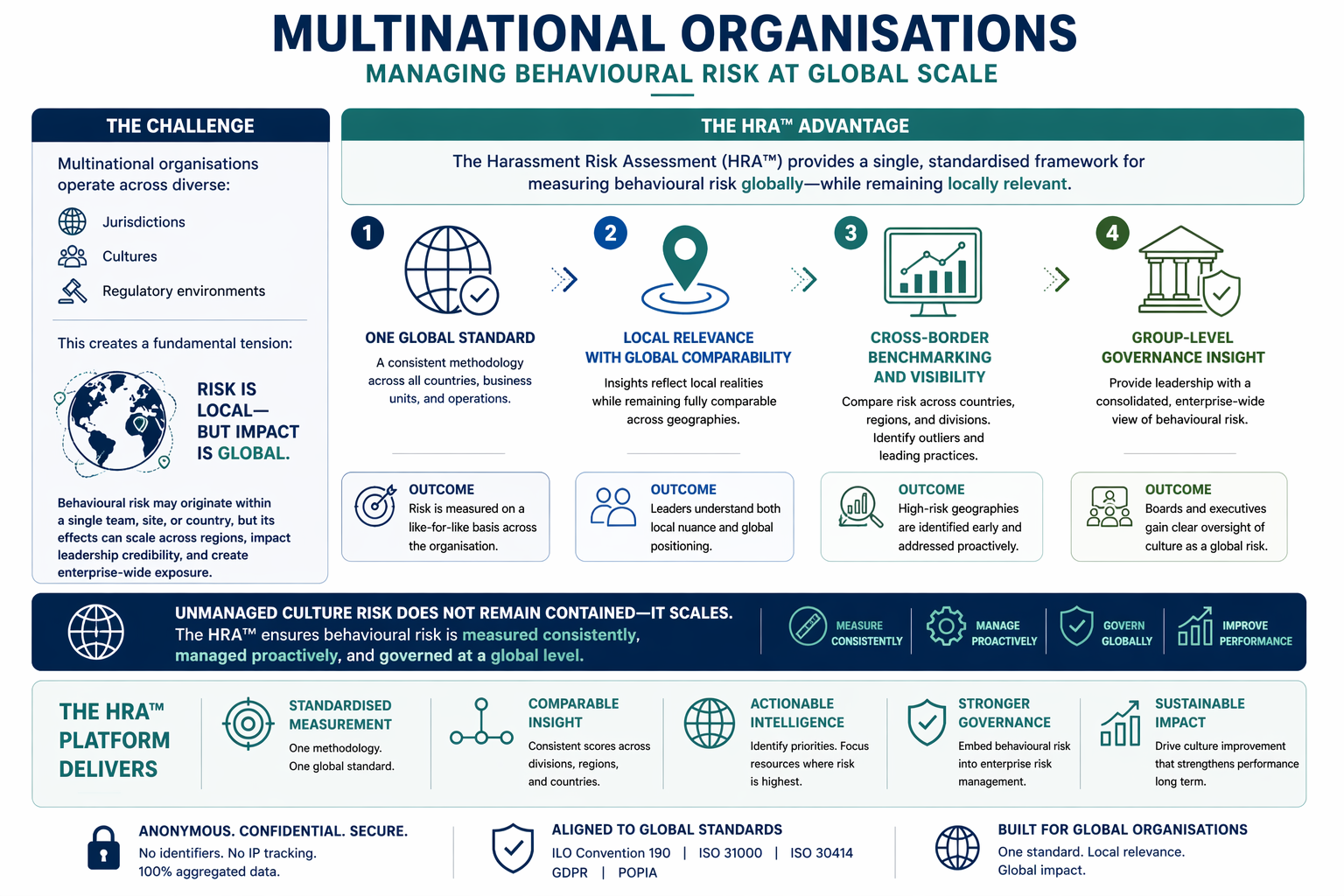
The Challenge
This creates a fundamental tension: Risk is local — but impact is global.
Multinational organisations operate across diverse:
jurisdictions
cultures
regulatory environments
Behavioural risk may originate within a single team, site, or country, but its effects can:
scale across regions
impact leadership credibility
create enterprise-wide exposure
The HRA™ Advantage
The Harassment Risk Assessment (HRA™) provides a single, standardised framework for measuring behavioural risk globally—while remaining locally relevant.
What This Enables
One Global Standard
A consistent methodology across all countries, business units, and operations.
Outcome:
Risk is measured on a like-for-like basis across the organisation.
Local Relevance with Global Comparability
Insights reflect local realities while remaining fully comparable across geographies.
Outcome:
Leaders understand both local nuance and global positioning.
Cross-Border Benchmarking and Visibility
Compare risk across:
countries
regions
divisions
Identify outliers and leading practices.
Outcome:
High-risk geographies are identified early and addressed proactively.
Group-Level Governance Insight
Provide leadership with a consolidated, enterprise-wide view of behavioural risk.
Outcome:
Boards and executives gain clear oversight of culture as a global risk.
Closing Insight
Unmanaged culture risk does not remain contained - it scales.
The HRA™ ensures behavioural risk is:
measured consistently
managed proactively
governed at a global level
8. Industry example mining study
Behavioural risk as a leading indicator of safety and performance
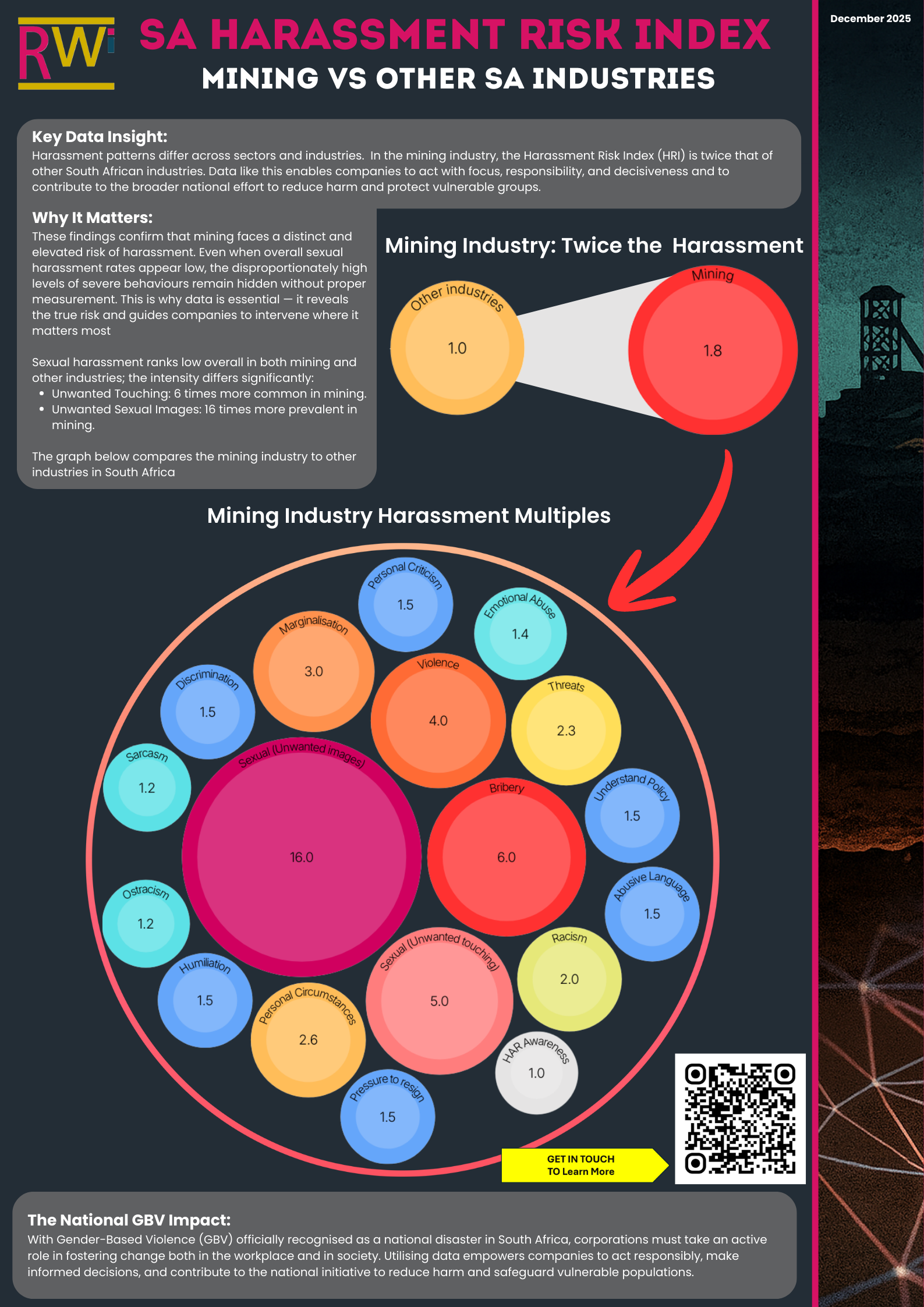
The mining industry provides a powerful example of how behavioural risk directly impacts operational outcomes. Through an academic study conducted in collaboration with industry partners, the HRA™ was applied within a mining environment to quantify workplace behavioural risk and its distribution across the workforce.
The findings highlighted elevated levels of behavioural risk relative to broader benchmarks, reinforcing the link between workplace behaviour, safety exposure, and overall performance. In high-risk environments such as mining, where operational discipline and decision-making are critical, unmanaged behavioural risk can act as a leading indicator of broader system failures.
This study demonstrates how the HRA™ enables mining organisations to move beyond policy and awareness toward measurable, risk-based management of workplace behaviour—supporting safer operations, stronger governance, and improved performance outcomes.
For further insight, see the Mining Weekly article link and the summary diagram below.
9. Why It Matters
The HRA™transforms culture into: A measurable, trackable, and governable performance indicator.
Behavioural risk is not only a people issue—it is a:
Performance risk
Governance risk
Scalable enterprise risk
Do not miss the opportunity to continue to lead and differentiate
A Global Governance Tool for Measuring and Managing Workplace Harassment Risk
✅Measure your Harassment Risk Index.
✅Define your risk posture.
✅Lead with data.
For more information or a discussion: https://hanlie.resilientwork.org/