
Why the Management of Harassment is a Governance Issue
Why the Management of Harassment is a Governance Issue
For many years, workplace harassment was viewed primarily as an HR issue.
When a complaint was made, HR investigated. When a policy needed updating, HR updated it. When training was required, HR delivered it.
While these activities remain important, leading organisations around the world are increasingly recognising that workplace harassment is not simply an HR matter - it is a governance issue.
The question is no longer whether an organisation has a policy.
The question is whether leaders have visibility of behavioural risks that could undermine performance, employee wellbeing, reputation, and organisational sustainability.
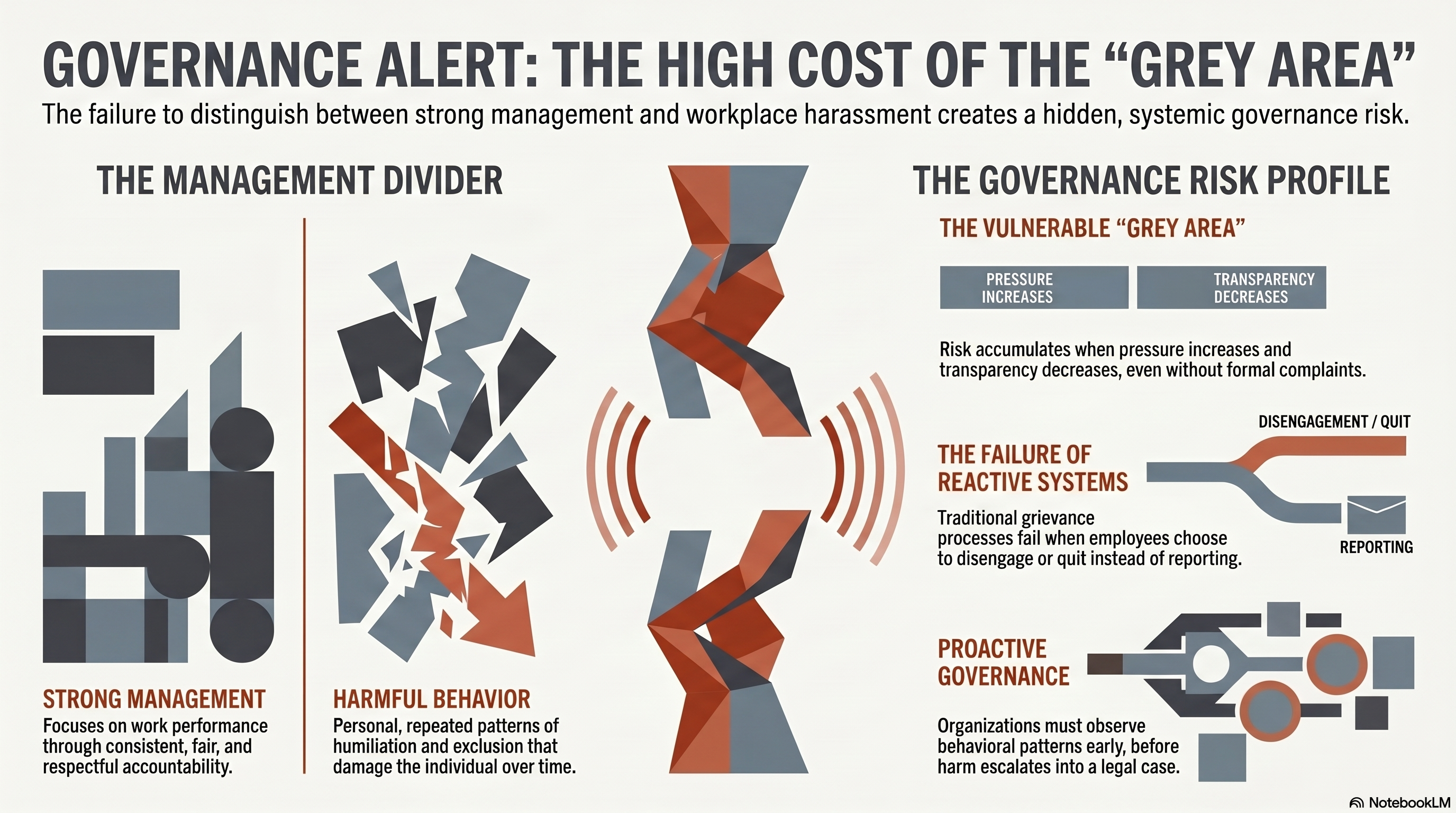
Harassment is a Risk, Not Just a Complaint
Most organisations manage harassment through a complaint process.
An employee experiences inappropriate behaviour.
A complaint is made.
An investigation follows.
A decision is reached.
This approach focuses on incidents that have already occurred.
Governance, however, is concerned with identifying and managing risks before they result in harm.
Boards do not wait for a financial crisis before reviewing financial controls.
They do not wait for a serious injury before managing safety risks.
Likewise, organisations should not wait for harassment complaints before understanding behavioural risks within their workforce.
Harassment should be viewed as a leading indicator of organisational risk rather than simply an individual complaint.
The Hidden Cost of Workplace Harassment
Workplace harassment impacts far more than the individuals directly involved.
Research consistently shows links between harmful workplace behaviours and:
Reduced employee engagement
Increased absenteeism
Higher staff turnover
Lower productivity
Increased stress and burnout
Reputational damage
Increased legal and compliance exposure
The absence of complaints does not necessarily mean the absence of risk.
In many organisations, employees remain silent due to fear, uncertainty, or a belief that reporting will not result in meaningful change.
As a result, harmful behaviours can remain invisible long before they become visible to management.
Governance Requires Visibility
Good governance depends on information.
Leaders cannot manage risks they cannot see.
Traditionally, organisations have relied on complaints, exit interviews, disciplinary cases, and employee relations matters to identify workplace issues.
These are valuable sources of information, but they are often retrospective.
By the time a grievance is filed, the risk has already materialised.
A governance approach asks a different question:
"What behaviours and patterns are emerging before they become formal complaints?"
This requires organisations to move beyond compliance and toward visibility.
The Difference Between Compliance and Governance
Compliance asks:
Do we have a policy?
Have employees received training?
Is there a reporting process?
Governance asks:
Do we understand where behavioural risks exist?
Which groups are most affected?
Are our interventions reducing risk over time?
What trends should concern leadership?
Compliance focuses on requirements.
Governance focuses on outcomes.
Both are necessary, but governance provides the oversight required to create sustainable workplaces.
Why This Matters for Botswana Organisations
Botswana organisations operate in an increasingly competitive environment where attracting, retaining, and developing talent is critical.
At the same time, expectations around ethical leadership, employee wellbeing, and responsible business conduct continue to increase.
Organisations that view harassment solely as an HR or Compliance issue risk missing important signals about culture, leadership effectiveness, and organisational health.
Those that treat harassment as a governance issue are better positioned to:
Identify risks early
Support leaders effectively
Improve employee trust
Strengthen organisational culture
Reduce operational and reputational risk
A Leadership Question
If workplace harassment is affecting productivity, morale, turnover, wellbeing, and organisational reputation, should it be viewed only as an HR issue?
Or should it be managed with the same discipline applied to other enterprise risks?
The organisations that lead in the future will be those that understand that workplace culture is not separate from performance.
It is one of the factors that determines it.
This educational writing is prepared jointly by On Trend Consulting and the Resilient Workplace Institute, a leading expert on workplace harassment & bullying.
Join the priority list for a free Botswana-focused session on workplace harassment risk
Click HERE
For more on On Trend HR Solutions, please read below:
On Trend HR Solutions is an agile consulting company that provides strategic human resources services to organisations, including end-to-end transactional human resources services for small and medium-sized companies. Our strength is in unlocking value for clients by leveraging the organisation’s data and in-depth research on industry and market trends to develop data-driven strategies and people-centred personalised solutions. We specialise in strategic resourcing, talent attraction and retention, culture, organisational transformation and change management, reward management, and employee relations.
This is a collaboration initiative of OnTrend HR Solutions with the Resilient Workplace Institute
OnTrend HR Solutions: follow us on LinkedIn
The Resilient Workplace Institute: follow us on LInkedIn