The difference between strong management and harmful behaviour
In many organisations across Botswana, there is a growing tension:
Leaders are expected to drive performance, hold teams accountable, and deliver results.
At the same time, organisations are becoming more aware of workplace bullying and harassment.
The challenge?
Where is the line between strong management and harmful behaviour?
This is where many organisations get it wrong.
Why this distinction matters
In Botswana, workplace bullying is not always clearly defined in a single piece of legislation. Instead, it is addressed through broader labour principles such as misconduct, unfair treatment, and constructive dismissal.
This creates a practical reality:
➡️ Many organisations only act when behaviour has already escalated
➡️ Leaders are often unsure what is acceptable
➡️ Employees struggle to distinguish between pressure and harm
Understanding the difference is not just an HR issue.
It is a leadership and governance responsibility.
What strong management looks like
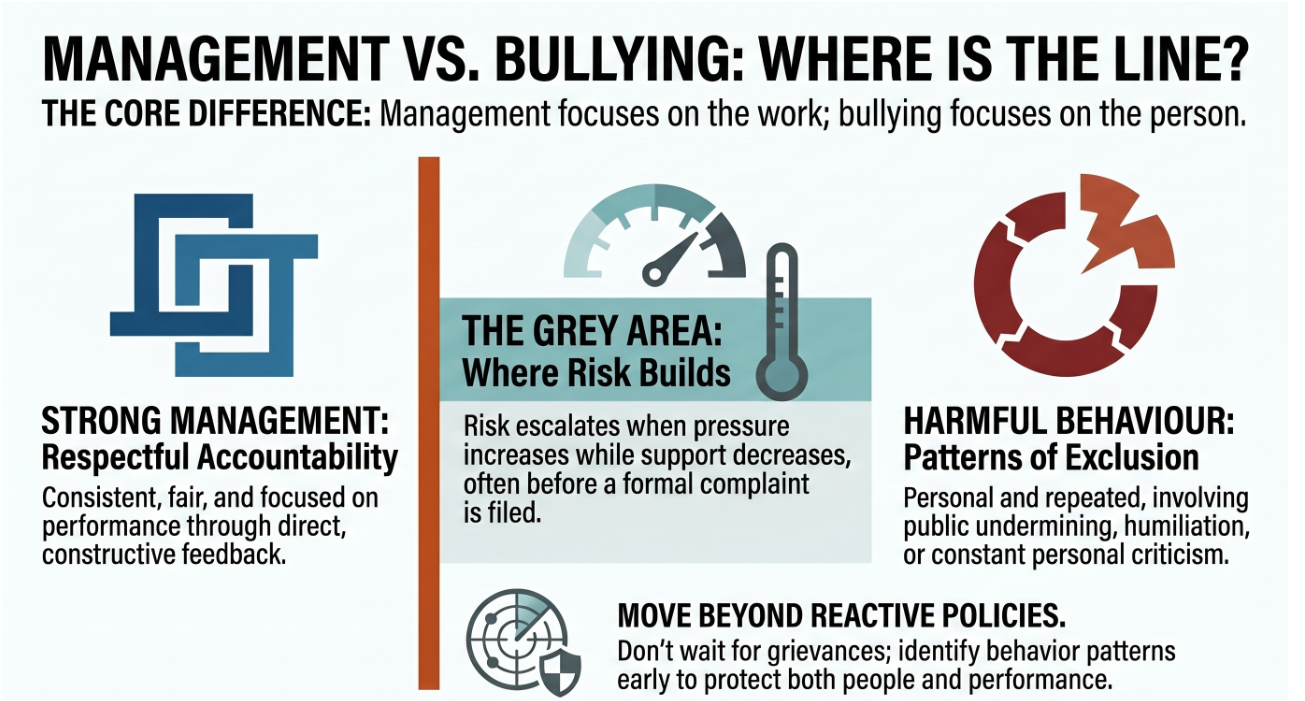
Strong management is necessary. Without it, performance declines, accountability weakens, and organisations lose direction.
Strong management includes:
Setting clear expectations
Holding employees accountable for results
Giving direct, constructive feedback
Making difficult decisions when required
Addressing underperformance
Importantly, strong management is:
➡️ Consistent
➡️ Fair
➡️ Respectful
➡️ Focused on work, not the person
Even when it is uncomfortable, it does not create fear or humiliation.
What harmful behaviour looks like
Harmful behaviour often starts subtly.
It is not always loud or obvious.
And it rarely presents as a single incident.
Instead, it shows up as patterns:
Constant personal criticism rather than work-focused feedback
Public undermining or humiliation
Excluding individuals from meetings or information
Intimidation, threats, or pressure
Unequal or inconsistent treatment
The key difference is this:
➡️ The behaviour becomes personal, repeated, and damaging over time
The grey area: Where risk builds
Most workplace risk does not sit at the extremes.
It sits in the grey area:
Feedback becomes more frequent - but more negative
Pressure increases - but support decreases
Decisions feel less transparent
Certain individuals feel consistently targeted
At this stage:
➡️ There may be no complaint
➡️ There may be no formal case
➡️ But the risk is already building
And this is where organisations are most vulnerable.
Why do many organisations only see this too late
Most organisations rely on:
Policies
Training
Grievance processes
These are important—but they are reactive.
They depend on someone:
recognising the problem
speaking up
and formally reporting it
But many employees do not report.
Instead:
they disengage
they withdraw
or they leave
The leadership question
The real question is not:
“Do we have a bullying problem?”
It is:
“Would we know if strong management has crossed into harmful behaviour?”
Because by the time it becomes a case, the impact is already visible:
on people
on performance
and on the organisation
Final thought
Strong management drives performance.
Harmful behaviour destroys it.
The difference is not always obvious - but it is measurable, observable, and manageable when organisations choose to look for it.
The organisations that lead will be those that:
Understand behaviour patterns early
Support leaders in managing correctly
And act before harm escalates
This educational writing is prepared jointly by On Trend Consulting and the Resilient Workplace Institute, a leading expert on workplace harassment & bullying.
Join the priority list for a free Botswana-focused session on workplace harassment risk
Click HERE
This is a collaborative initiative between OnTrend HR Solutions and the Resilient Workplace Institute.
For more on On Trend HR Solutions, please read below:
On Trend HR Solutions is an agile consulting company that provides strategic human resources services to organisations, including end-to-end transactional human resources services for small and medium-sized companies. Our strength is in unlocking value for clients by leveraging the organisation’s data and in-depth research on industry and market trends to develop data-driven strategies and people-centred personalised solutions. We specialise in strategic resourcing, talent attraction and retention, culture, organisational transformation and change management, reward management, and employee relations.
On Trend HR Solutions: Follow us on LinkedIn
The Resilient Workplace Institute: Follow us on LinkedIn